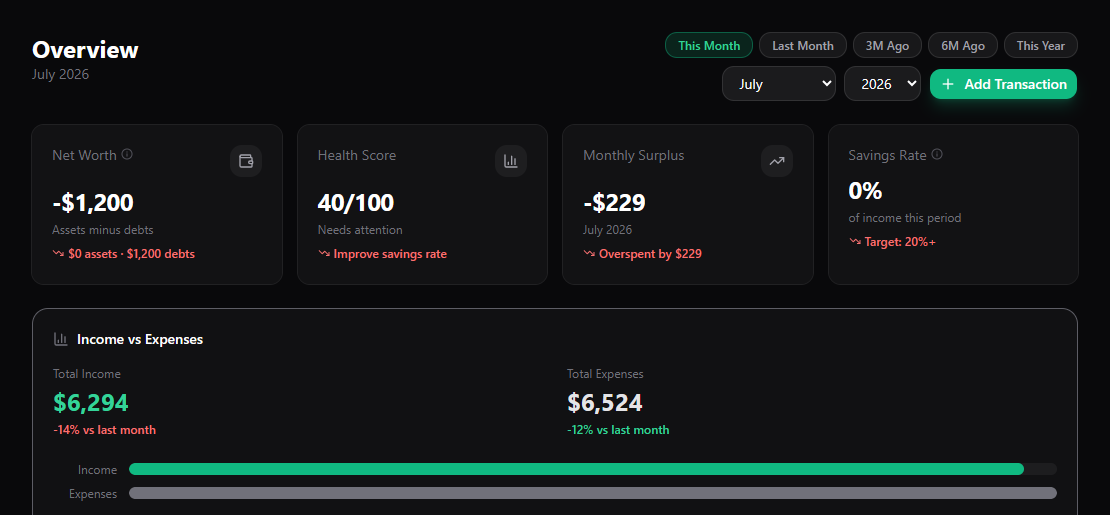
Mint shut down in January 2024. If you're reading this in 2026 and still haven't settled on a replacement, you're not slow — you're one of a surprisingly large group of people who picked a stopgap (a spreadsheet, Credit Karma, nothing at all) and are only now hitting its limits.
This post is a straight comparison of the six apps actually worth considering as best mint alternatives 2026: Monarch Money, YNAB, Copilot, Rocket Money, Empower, and SpendGuard. Real pricing, real strengths, real trade-offs — including the ones that don't work in SpendGuard's favor.
Last updated: July 16, 2026.
Quick Answer
- Want the closest thing to Mint? Monarch Money — bank-linked, polished, built for the same job Mint did.
- Want to actually change your spending habits? YNAB — a real budgeting method, not just a dashboard.
- Want the best-looking app and don't mind Apple-first? Copilot — sharp design, smart auto-categorization.
- Want to kill subscriptions you forgot about? Rocket Money — its cancellation tool is genuinely useful, the budgeting tools less so.
- Want free net-worth tracking and don't mind sales calls? Empower — free forever, because it's a funnel into their advisory business.
- Want to avoid handing over bank credentials at all? SpendGuard — manual entry works fully, with an AI advisor and a real free tier.
| App | Starting price | Bank linking | Free tier |
|---|---|---|---|
| Monarch Money | $14.99/mo (~$99.99/yr) | Required | 7-day trial only |
| YNAB | $14.99/mo (~$99/yr) | Optional, built around it | 34-day trial, free for students |
| Copilot | $13/mo (~$95/yr) | Required | 30-day trial |
| Rocket Money | Free tier + paid from ~$7–14/mo | Required | Yes, limited |
| Empower | Free (monetized via advisory) | Required | Yes, unlimited |
| SpendGuard | Free / $12/mo Pro / $24/mo Premium | Optional, not required | Yes, unlimited |
Monarch Money: The Closest Thing to Mint
Monarch is the most direct Mint replacement on this list. It links to your accounts via Plaid, pulls transactions automatically, and gives you the same kind of spending-by-category dashboard Mint users grew up on — plus collaborative budgeting for couples, which Mint never did well.
The interface is polished and the roadmap is active. If what you actually miss about Mint is the all-in-one aggregated view, Monarch gets you there fastest.
The catch is price: $14.99/mo or roughly $99.99/year, with only a 7-day trial before you're paying. After years of a free tool, that's a real adjustment, and there's no meaningful free tier to fall back on. Monarch also now splits into two tiers — the standard Core plan at that price, and a Plus tier at $199/year for power users who want deeper financial modeling.
Best for: couples and households who want a Mint-like aggregated view and are fine paying premium-app pricing for it.
YNAB: The Discipline System
YNAB (You Need A Budget) isn't really a Mint replacement — it's a different philosophy. Instead of showing you what you already spent, it makes you assign every dollar of income to a job before you spend it (zero-based budgeting).
It's genuinely effective for people who live paycheck to paycheck or consistently overspend — the method forces awareness that a passive dashboard doesn't. It works with manual entry or bank sync, so it's more flexible on that front than Monarch or Copilot.
It's also priced the same as Monarch ($14.99/mo, ~$99/year) and the learning curve is real. Give-every-dollar-a-job takes a few weeks to click. If you want a five-minute setup and a dashboard, YNAB will frustrate you.
Best for: people with an overspending problem who want a method, not just a mirror.
Copilot: The Best-Looking App
Copilot's pitch is design and automation: transactions get auto-categorized well, the interface is one of the cleanest in this category, and it leans on AI to summarize your spending trends without much manual tagging.
The trade-off is platform reach. Copilot started iOS/Mac-only and is still strongest there, so if you're on Android or Windows-first, check current platform support before committing. It also requires bank linking to be useful; there's no real manual-entry mode.
At $13/mo (or ~$95/year), it undercuts Monarch and YNAB slightly, but it's still a premium-app price with a 30-day trial, not an ongoing free tier.
Best for: Apple users who care about interface quality and want automation to do most of the work.
Rocket Money: Subscription Killer, Budgeting Afterthought
Rocket Money built its reputation on one specific job: finding subscriptions you forgot you're paying for and canceling them for you. That feature alone has probably saved its users real money, and it's still the best reason to use the app.
Its budgeting and net-worth tools are functional but secondary — noticeably thinner than Monarch's or YNAB's if that's your main use case. The free tier exists and covers subscription tracking; the paid tier (roughly $7–14/mo, pay-what-you-choose) unlocks fuller budgeting and credit monitoring. Worth knowing: its bill-negotiation service takes a cut of whatever it saves you, which is a different business model than a flat subscription.
Best for: people whose main problem is subscription creep, not full budget tracking.
Empower: Free, But You're the Lead
Empower (formerly Personal Capital) offers genuinely free net-worth tracking, spending breakdowns, and an investment "checkup" tool with no subscription fee and no time limit. For a no-cost Mint replacement focused on net worth and investments, it's hard to beat on price.
The reason it's free: Empower's business is wealth management, not software. The free tools exist to identify people with meaningful investable assets and route them to a paid advisor, and fees start at 0.89% of assets under management for most clients (that rate only steps down below 0.49% on the portion above $10M, which won't apply to the large majority of readers). Expect calls and emails pitching that service, especially if your linked accounts show a decent balance. If you don't have $100k+ in investments, you're less likely to be a priority for their team, and the budgeting side of the app is noticeably thinner than dedicated budgeting apps.
Best for: people who mainly want free net-worth and investment tracking and don't mind being a lead for a wealth advisor.
SpendGuard: Built for People Who Don't Want to Link a Bank Account
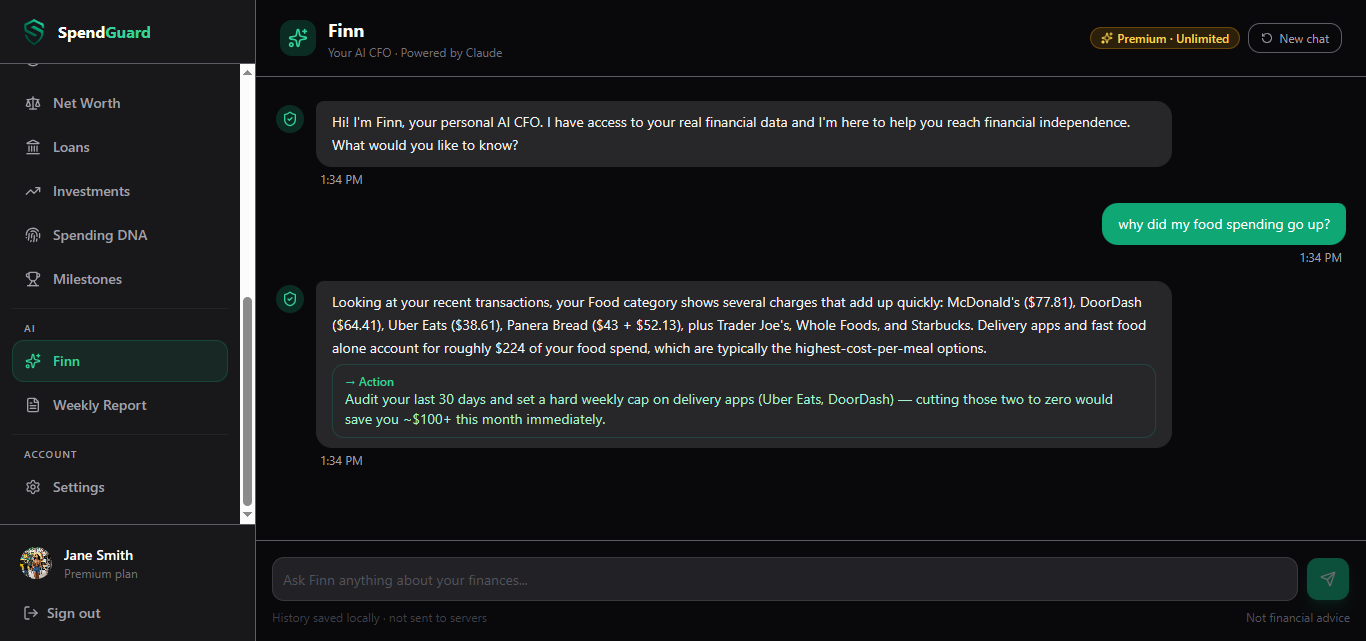
SpendGuard takes a different angle than the other five apps on this list: every one of them expects you to hand over bank credentials through Plaid to get real value. SpendGuard doesn't. Manual entry gets you the full app — budgets, an AI advisor, a FIRE calculator, net worth tracking — with bank sync planned as an optional add-on later, never a requirement.
That matters most for people who avoid checking their finances specifically because linking a bank account feels like one more account that could get breached. If that's your blocker, SpendGuard is built around removing it rather than working around it.
The AI advisor, Finn, is the other differentiator: instead of just showing "$320 on dining last month," it answers direct questions about your actual numbers — savings rate, category trends, what a given change does to your FIRE date. CSV/Excel import is also live on the paid plan, so you can bulk-load a bank statement without linking anything live.
The honest trade-off: SpendGuard is a smaller, newer product than Monarch or Empower. It doesn't have Monarch's years of aggregation polish or Empower's investment-advisory depth, and there's no collaborative couples mode yet. What it does have is a real free tier (500 transactions/month, 3 budget categories, 5 Finn questions/day, no card required) and paid tiers that undercut the rest of this list — Pro at $12/mo and Premium at $24/mo, versus $13–15/mo for a single tier elsewhere. Full breakdown on the pricing page.
Best for: people who want to budget and get AI-driven guidance without linking a bank account, and who don't need multi-user collaboration yet.
How to Choose
Match the app to the actual problem, not the brand recognition:
- Miss Mint's aggregated dashboard specifically → Monarch.
- Actually overspend and need a method → YNAB.
- Want the cleanest interface and live on Apple → Copilot.
- Bleeding money on forgotten subscriptions → Rocket Money.
- Want free net-worth tracking and don't mind advisory outreach → Empower.
- Don't want to link a bank account at all, or want AI-driven answers about your money → SpendGuard.
Most of these have a free trial. Given how much this decision shapes your day-to-day money habits, it's worth running two apps side by side for a week before committing to an annual plan. Check our FAQ if you're weighing the bank-linking question specifically — it's the one that trips people up most.
Get your finances on track with SpendGuard
Track spending, plan your FIRE date, and get AI-powered advice — all in one place. Free to start.
Start for free →